

Sleep Health is a relatively new field of research exploring how we sleep and the factors that impact it. It is an important area of research and study because adequate sleep is a critical determinant of health and well-being. Moreover, sleep is a basic requirement for infant, child, and adolescent health and development.
According to the National Sleep Foundation’s annual Sleep in America poll for 2018, the study showed that only 10% of American adults prioritize their sleep over other aspects of daily living such as fitness/nutrition, work, social life, and hobbies/personal interests.
When asked which of the five items was most important to them personally, 35% said fitness/nutrition, 27% said their work, 17% said hobbies/personal interests, 10% said sleep, and 9% said their social life.
Furthermore, the results of the National Sleep Foundation’s (NSF) quarterly Sleep Health Index® showed little change in the nation’s sleep health, with the overall score remaining at a strong 76 out of 100. The greatest shift was seen in one aspect of sleep duration, with American adults getting more weekday sleep. The Sleep Health Index results are not all good, though, as sleep quality remains at a disappointing 67.
At North Dallas ENT we share the views of the NSF, where we are dedicated to promoting healthy sleep for all and wish to raise awareness of the importance of sleep, treatment for sleep problems and the consequences of sleep loss.
There are many positive benefits of maintaining good sleep health, as it can actually help you to ward off diseases, improve memory, decrease inflammation, lower risk of obesity, control blood sugar, and improve your mood.
When you get adequate sleep, it helps to reduce heart rate and blood pressure, slows breathing to a normal pace, and releases growth hormones to rebuild muscles and joints. All this helps the body refuel and repair itself.
The National Sleep Foundation recommends the following hours of sleep per age group:
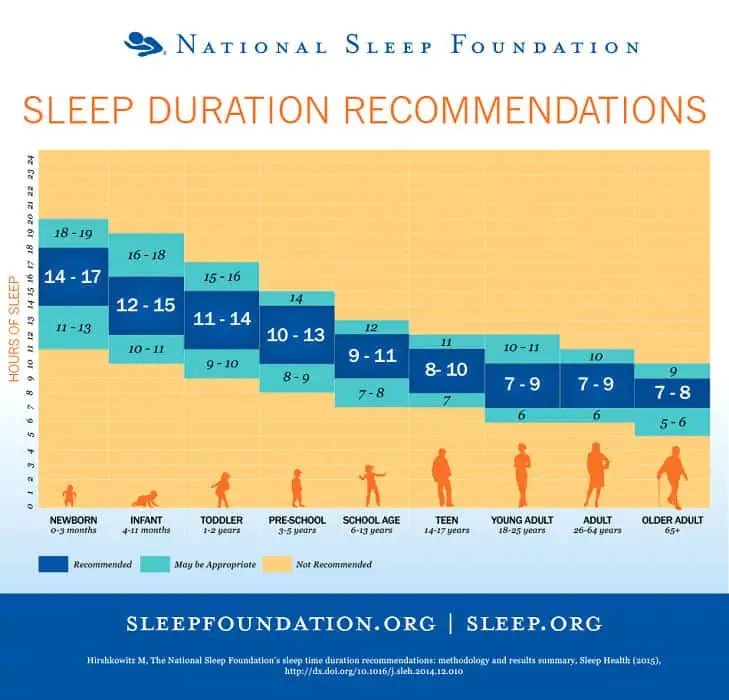
Normal sleep is when you fall asleep quite easily, do not wake up during the night, do not wake up too early, and feel refreshed in the morning.
During several hours of normal sleep, your brain cycles through four stages of sleep every 90 to 110 minutes. These sleep cycles include the 3 stages of non-REM sleep (light to deep sleep) and REM sleep. REM is short for rapid eye movement–describing the quick eye movement that can be observed during deep sleep. Dreaming occurs during REM sleep.
There are several sleep satisfaction elements to consider when evaluating your sleep, such as explaining how you feel (a) about your sleep, (b) immediately after your sleep, and (c) during the subsequent day. Then evaluate your environmental elements, such as (a) bedding comfort, (b) bedroom temperature, and (c) noise and light in the bedroom. Also, evaluate how you feel about (a) the time it takes to fall asleep, (b) the ease with which you fall back to sleep after awakening during a sleep period, and (c) the amount of sleep on weekdays and weekends, as well as how undisturbed your sleep is. These are all appropriate contributors to sleep satisfaction.
Developing good sleep habits (or sleep hygiene) is important to get a good night’s sleep, and it requires some motivation to make a change. Here are some tips to follow to improve your sleep:
If you have chronic difficulty sleeping, you should contact your doctor for evaluation and treatment, preferably one familiar with assessing and treating sleep disorders.
Before your visit, you should keep a diary of your sleep habits for about 10 days and then discuss it with your doctor. For your sleep diary, you should record when you go to bed, go to sleep, wake up, get out of bed, take naps (if any), exercise, consume alcohol, and consume caffeinated beverages.
Here is an example sleep diary from the American Academy of Sleep Medicine.
Biological clocks produce circadian rhythms and regulate their timing. Circadian rhythms are physical, mental, and behavioral changes that follow a daily, 24-hour cycle. They respond primarily to light and darkness in your environment. For example, sleeping at night and being awake during the day is a light-related circadian rhythm
The master clock is a group of about 20,000 nerve cells (neurons) that form a structure called the suprachiasmatic nucleus (SCN). The SCN is located in the part of the brain called the hypothalamus and it receives direct input from the eyes. The master clock is responsible for coordinating all the biological clocks in the body, keeping them in sync.
Natural factors within the body produce circadian rhythms, as well as signals from the environment, such as daylight. The light can turn on or turn off genes that control the molecular structure of biological clocks. Changing the light-dark cycles can speed up, slow down, or reset biological clocks as well as circadian rhythms.
Circadian rhythms help determine our sleep patterns. The body’s master clock controls the production of melatonin, a hormone that makes you sleepy. It receives information about incoming light from the optic nerves, which relay information from the eyes to the brain. When there is less light–like at night–the SCN tells the brain to make more melatonin so you get drowsy.
Travel can disrupt your circadian rhythm, and result in jet lag. Passing through different time zones resets your biological clocks, and consequently, it takes a few days for your biological clocks to adjust and reset themselves.
Circadian rhythms can influence sleep-wake cycles, hormone release, eating habits and digestion, body temperature, and other important bodily functions. If your biological clocks run fast or slow, it can result in disrupted or abnormal circadian rhythms. As a result, irregular rhythms have been linked to various chronic health conditions, such as sleep disorders, obesity, diabetes, depression, bipolar disorder, and seasonal affective disorder.
Circadian rhythm research helps scientists understand how biological clocks work and keep time. Researchers study humans and perform experiments altering light and dark periods in a subject’s environment to look for changes in gene activity or other molecular signals. It also helps scientists identify which genetic components of biological clocks may be broken, causing irregular circadian rhythms.
This research not only gives scientists a better understanding of how our biological clocks tick, but also leads to innovations in treatments for sleep disorders, obesity, mental health disorders, jet lag, and other health problems. It can also improve ways for individuals to adjust to nighttime shift work.
Sleep loss and untreated sleep disorders can result in negative behaviors affecting family health and interpersonal relationships. Furthermore, fatigue and sleepiness can reduce productivity and increase the chance for mishaps such as medical errors and motor vehicle or industrial accidents.
Sleep is important for overall health and well-being. If you don’t get enough sleep, poor-quality sleep increases your risk of heart disease, high blood pressure, kidney disease, obesity, stroke, and type 2 diabetes.
There are many factors that cause sleep problems, including aging; environmental (alcohol and drugs use, extreme temperatures); genetics (narcolepsy); grinding your teeth; life stresses (death of a loved one, job demand, loss or change, moving); medical issues (asthma, allergies, chronic pain); medications (antidepressants, blood pressure medications, over-the-counter cold medicines); mental illness (depression and anxiety); physical disturbances (pain from ulcers, hot flashes due to menopause, frequent urination due to an enlarged prostate); snoring, travel (jet lag); and work shifts at odd hours.
A sleep disorder (somnipathy) is any disruption in your sleep pattern that interferes with your normal physical, mental, social, and emotional functioning.
Generally, symptoms of a sleep disorder depend on the type of disorder you may have, but you might feel very sleepy during the day, have trouble falling or staying asleep, snore, stop breathing briefly and often while asleep, and have uncomfortable feelings in your legs and the urge to move them.
There are several different types of sleep disorders that can affect how well you sleep, some of which are described below:
Insomnia. Inability to initiate or maintain sleep; early morning awakening and inability to resume sleep.
Narcolepsy. Excessive daytime sleepiness and sudden muscle weakness; experience uncontrollable “sleep attacks” (fall asleep suddenly).
Restless Legs Syndrome (RLS). Unpleasant “creeping” sensation or throbbing in the lower legs; irresistible urge to move them.
Sleep Apnea. Loud snoring with periodic gasping or “snorting” noises; breathing stops and starts over and over while sleeping.
Sleep Walking. Get out of bed and wander around at night without knowing it.
If you suspect that you have a sleep disorder, discuss your symptoms with your primary care doctor. He or she can perform a physical exam and help you identify the difficulties you are having with sleep. Keeping a sleep diary for 2 weeks may be helpful to your doctor. Some illnesses can cause disturbed sleep, so your doctor may order tests to rule out other conditions.
If your doctor suspects that you have a sleep disorder, you may be referred to a sleep disorder clinic to undergo a sleep study.
A sleep study or polysomnogram (PSG) is a multiple-component test that electronically transmits and records specific physical activities while you sleep. The sleep specialist will analyze the recorded data to determine whether or not you have a sleep disorder. For select patients, the sleep study can be done at home (home sleep testing).
Snoring can be disruptive to both you and your bed partner and is often a sign of underlying obstructive sleep apnea.
If you have issues with habitual snoring, medical assistance is available to help you and your bed partner get a good night’s sleep. Your ENT doctor will review your signs and symptoms and your medical history, perform a physical examination, and order tests (e.g., x-ray, CT scan, MRI) if necessary, to determine the cause and recommend corrective treatment options.
The treatment for sleep disorders depends on the type of disorder you have. For sleep apnea, it can either be medically managed or surgically corrected. Your doctor will recommend the best treatment option that helps you to maintain an open airway during sleep. If you have narcolepsy or restless legs syndrome, your doctor may recommend some lifestyle changes and prescription medication. And if you have insomnia, your doctor may also prescribe medication, and/or recommend therapies that calm your breathing and calm your mind
If you have sleep issues, call North Dallas ENT at
(214) 382-5100 to schedule a consultation. Having a proper diagnosis and treatment could improve your sleep and your overall well-being.



For New Year's Eve week, we will close the office from December 31st at noon to January 1st.
We will be open during normal business hours on Thursday, January 2nd.
Happy New Year!